Quantum Advantage Is Now a Contest, Not a Finish Line — And That Changes How Professionals Should Plan
On 30 July 2026, IBM and three research partners announced quantum advantage — three times, in a single day. Ten weeks earlier, on 21 May 2026, a team at the Flatiron Institute and Boston University published work in Science showing that a laptop running tensor-network methods could reproduce results a commercial vendor had previously described as beyond classical reach.
Both things are true. Neither is a contradiction. Together they describe the actual condition of quantum applications in 2026: advantage is not a line a machine crosses once and holds forever. It is a contested claim, defended against a classical community that keeps getting better, and it can be withdrawn.
This matters for anyone who has to make a decision on the basis of quantum news — a CTO deciding whether to fund a pilot, a research scientist choosing a computational method, a security architect scoping a migration, a developer deciding what to learn. The dominant public narrative frames quantum as a countdown. That framing produces bad decisions in both directions: premature spending on workloads that will not benefit, and complacency about the one transition that has published deadlines attached to it.
This article argues for a different frame. It maps quantum application classes by strength of evidence rather than by enthusiasm, explains why molecular and materials simulation is genuinely ahead while optimisation is not, and sets out what a defensible 2026 position looks like. Every factual claim is sourced; where the evidence is preliminary, contested, or a company claim rather than an independent finding, the text says so.
Executive summary
- Quantum advantage claims are now adversarial by design. IBM's July 2026 demonstrations were published to a public Quantum Advantage Tracker specifically so that classical researchers could attempt to break them — a meaningful methodological improvement over press-release-first announcements.
- Advantage claims have a track record of being narrowed or overturned. A May 2026 Science paper using tensor networks and belief propagation reproduced, on a laptop, spin-glass dynamics that D-Wave's 2025 Science paper had presented as beyond classical simulation.
- Simulation of quantum systems is the strongest application class. It has the clearest theoretical motivation, the most credible demonstrations, and the least exposure to classical dequantisation — though "credible demonstration" still does not mean "commercially superior today."
- Optimisation is the weakest mainstream claim. No general quantum speedup for combinatorial optimisation has been established, and several reported annealing advantages have been closed by improved classical solvers, most recently in Physical Review Applied in July 2026.
- Verification is the real bottleneck. Once a computation exceeds classical simulability, proving the answer is correct becomes a research problem in itself — which is precisely what IBM's three July papers addressed.
- Hardware roadmaps are converging on 2029–2030 for the first genuinely fault-tolerant systems, but these are vendor targets, not delivered results, and should be planned against as such.
- Post-quantum cryptography is the only quantum-related programme with firm published deadlines. NIST finalised FIPS 203, 204 and 205 in August 2024; NIST IR 8547 proposes deprecating RSA-2048 and ECC P-256 after 2030 and disallowing them after 2035.
- The correct near-term posture for most organisations is capability-building, not capacity-buying — cryptographic inventory, problem-class literacy, and a small number of instrumented pilots with honest classical baselines.
Why "when will quantum beat classical?" is the wrong question
The question assumes a single, permanent crossing point. The history of the field does not support that assumption.
Every headline quantum advantage result since 2019 has triggered a classical counter-effort, and several have been substantially eroded. This is not a scandal — it is how computational complexity claims are supposed to be tested. But it has a practical consequence that few enterprise quantum strategies account for: an advantage claim is a statement about the state of classical algorithms at a moment in time, not a permanent property of a quantum machine.
The May 2026 Science result illustrates this sharply. Joseph Tindall and colleagues at the Flatiron Institute's Center for Computational Quantum Physics, working with Boston University, combined two- and three-dimensional tensor networks with a belief-propagation algorithm whose origins date to the 1980s. They reproduced spin-glass dynamics across square, cubic, and diamond lattices that D-Wave's March 2025 Science paper had associated with quantum necessity — and Tindall ran much of it on a personal laptop using the ITensor library. D-Wave has published a technical rebuttal; the disagreement is live rather than settled. That is the point.
Contrast this with how IBM handled its July 2026 announcements. The three sets of circuits and results were posted to a public Quantum Advantage Tracker — in one case eight months before the corresponding press release — inviting classical researchers to attempt refutation continuously. Jay Gambetta, director of IBM Research, framed the moment as "the quantum advantage era." The rhetoric is promotional. The methodology underneath it is a genuine improvement, and professionals should reward it by evaluating the method rather than the adjective.
Editorial callout — the reading rule When you see an advantage claim, ask four questions: What classical methods were it tested against? Were the circuits and data released for independent challenge? How long has the claim survived public scrutiny? Is the task itself commercially meaningful, or a physics benchmark? A claim that answers all four well is worth attention. A claim that answers none is a marketing artefact.
Latest developments: what actually happened, with dates
Recent activity is dense enough that specific dates matter more than the general impression of momentum.
30 July 2026 — IBM's three advantage demonstrations. Preprints were posted to arXiv on 27 and 28 July, with a press conference on 28 July and announcements on 30 July. All three ran on IBM Heron R3 processors. With Qedma, researchers studied a two-dimensional Floquet transverse-field Ising model at up to 74 qubits using Qedma's QESEM error-mitigation software, benchmarked against classical methods including runs on RIKEN's Fugaku supercomputer, with support from BlueQubit. With Algorithmiq, the team simulated a heterogeneous quantum material. With the University of Chicago, the demonstration used logical (encoded) circuits and a doped-Clifford construction with complexity-theoretic hardness arguments. Important qualification: these are preprints, not yet peer-reviewed, and independent analysts have noted that the three papers carry different evidentiary weight — the Chicago result makes the most formal claim, while the Qedma and Algorithmiq results are empirical statements about where tested classical methods became unreliable.
21 May 2026 — the tensor-network counterexample. Published in Science by Tindall, Mello, Fishman, Stoudenmire and Sels, as described above.
May 2026 — quantum-centric supercomputing at protein scale. A Cleveland Clinic, RIKEN and IBM collaboration calculated electronic structure for protein-ligand complexes of up to 12,635 atoms (Trypsin; T4-Lysozyme at 11,608 atoms), roughly four months after the same team first modelled the 303-atom Trp-cage miniprotein. Quantum sampling ran on two 156-qubit Heron r2 processors using up to 94 qubits, with classical post-processing on Fugaku and Miyabi-G. The honest reading is in IBM's own words: the workflow "performs at a level comparable with established classical methods." It is a scaling and architecture achievement, not yet a demonstration that quantum beats classical chemistry.
8 July 2026 — an optimisation advantage narrowed. A paper in Physical Review Applied showed that a GPU-based simulated bifurcation machine matched or exceeded the scaling reported for quantum annealing on QUBO problems in a 2025 Physical Review Letters study, and argued the earlier instances were too small to support asymptotic conclusions.
22 October 2025 — verifiable advantage in Nature. Google Quantum AI reported its Quantum Echoes (out-of-time-order correlator) algorithm on the Willow processor, claiming roughly 13,000× speedup over the best classical method tested on a leading supercomputer, and describing the result as cross-checkable on another quantum computer of similar quality. A companion preprint with UC Berkeley applied the technique to two organic molecules alongside NMR measurements — a proof of principle, explicitly not yet peer-reviewed at announcement.
Hardware roadmap markers. IBM's Nighthawk processor (120 qubits, 218 tunable couplers) and Loon processor were unveiled in November 2025, alongside an FPGA-based decoder processing error syndromes in under 480 nanoseconds — about ten times faster than prior iterations and delivered a year ahead of IBM's own schedule. Quantinuum's Helios launched commercially in November 2025 with 98 physical qubits yielding 48 logical qubits; its SEC filings target Sol at roughly 100 logical qubits in 2027 and Apollo at hundreds of logical qubits in 2029. These are company roadmaps, and Quantinuum's own filings carry the standard risk disclosure that the technology may never meet stated specifications.
An evidence map of quantum application classes
Grouping applications by evidential strength is more useful than grouping them by industry. The table below is an original synthesis for OneWise.
Table 1 — Quantum application classes by strength of evidence, August 2026
| Application class | Representative workload | Strongest 2025–26 evidence | Exposure to classical rebuttal | Realistic horizon for decision-grade use |
|---|---|---|---|---|
| Quantum many-body & materials simulation | Driven Ising models, spin dynamics, correlated electrons | IBM/Qedma and IBM/Algorithmiq preprints (Jul 2026); Google Quantum Echoes, Nature (Oct 2025) | Moderate — tensor networks improve, but the theoretical motivation is native | Selective research use now; broader use likely fault-tolerance-dependent |
| Quantum chemistry via hybrid workflows | Ground-state energies of molecular fragments; protein-ligand complexes | Cleveland Clinic/RIKEN/IBM SQD results (Mar & May 2026) | Moderate–high — classical embedding methods are strong and improving | Comparable to classical today; advantage plausible but unproven |
| Combinatorial optimisation | Scheduling, routing, portfolio construction, QUBO problems | Decoded quantum interferometry, Nature (2025) — a structured, theoretical result | High — repeatedly narrowed by improved classical solvers | No credible near-term commercial advantage |
| Quantum machine learning | Kernel methods, generative models on quantum data | Mostly small-scale demonstrations; heuristic | Very high — dequantisation results are common | Speculative; treat vendor claims with particular caution |
| Cryptanalysis (Shor-class) | Factoring RSA-2048, discrete logs | Resource estimates only; Gidney (2025) estimates under one million noisy qubits | Not applicable — the algorithm's speedup is proven | Not achievable on current hardware; but drives real deadlines today |
Two observations follow from this map, and they cut in opposite directions.
First, the enthusiasm is concentrated in the wrong place. Enterprise interest has historically clustered around optimisation, because every business has scheduling and routing problems. But optimisation is the class with the weakest theoretical foundation. The 2024 Nature Reviews Physics survey by Abbas and colleagues is direct about this: the barriers to quantum advantage in optimisation are substantial and not merely engineering barriers. Babbush and co-authors argued as early as 2021 that quadratic speedups alone are unlikely to survive realistic error-correction overheads — which removes Grover-style arguments from serious near-term planning.
Second, the strongest class is also the least commercially legible. Simulating a driven Ising model is genuinely hard classically and genuinely native to quantum hardware. It is also not something most companies buy. The path from "we can model spin dynamics no supercomputer can match" to "we found a better battery electrolyte" runs through many intermediate scientific steps, and honest practitioners do not claim otherwise.
Why verification became the central application problem
There is a structural irony at the heart of useful quantum computing: the moment a quantum computer becomes useful is the moment you can no longer check its answer classically.
For benchmark tasks this was tolerable — random circuit sampling could be certified statistically, imperfectly. For applications it is not. A pharmaceutical company will not act on a binding-energy prediction it cannot validate. A materials group will not publish a phase diagram it cannot cross-check.
This is why the July 2026 IBM papers are more interesting as verification research than as advantage claims. Each attacked the trust problem differently: device-dependent fidelity certificates, cross-checking against a different hardware modality (a Quantinuum machine was used to confirm parts of the Qedma work), and consistency-under-scaling arguments where classical methods began producing inconsistent results while quantum outputs remained stable.
None of these is a general solution. A July 2026 preprint by Oh has already questioned whether sample-only ensemble statistics suffice to certify random circuit sampling. The verification literature is young and contested. But professionals should note the shift: credibility in quantum applications is migrating from speed claims to trust claims, and vendors who invest in independent verifiability are making a more durable bet than those who publish speedup multipliers.
The one deadline that is not speculative
Everything above concerns capability that may or may not arrive on schedule. Cryptographic migration is different: the deadlines are published, they are binding on many organisations, and they do not depend on when a cryptographically relevant quantum computer appears.
NIST finalised its first three post-quantum standards on 13 August 2024: FIPS 203 (ML-KEM, key encapsulation), FIPS 204 (ML-DSA, digital signatures) and FIPS 205 (SLH-DSA, hash-based signatures). HQC was selected in March 2025 as a code-based backup key-encapsulation mechanism with different mathematical foundations.
Table 2 — Published post-quantum transition milestones (planning reference)
| Date | Requirement | Source | Applies to |
|---|---|---|---|
| 13 Aug 2024 | ML-KEM, ML-DSA, SLH-DSA finalised | NIST FIPS 203/204/205 | Global reference standards |
| 1 Jan 2027 | New National Security System acquisitions must support quantum-resistant algorithms | NSA CNSA 2.0 | US NSS and their supply chains |
| After 2030 | RSA-2048, ECC P-256 and related algorithms deprecated (continued use requires documented risk acceptance) | NIST IR 8547 (initial public draft) | US federal systems; widely used as a global planning anchor |
| 2033 | Exclusive CNSA 2.0 use targeted for operating systems, cloud and web services | NSA CNSA 2.0 | US NSS |
| 2035 | Quantum-vulnerable public-key algorithms disallowed | NIST IR 8547; NSM-10 | US federal systems |
Two caveats matter. NIST IR 8547 was published as an initial public draft in November 2024; treat its dates as strong signals rather than final regulation, and check for the finalised version. And these are US instruments — the European Union published a coordinated PQC roadmap through the NIS Cooperation Group in June 2025, with its own timelines.
The driver is "harvest now, decrypt later": encrypted data intercepted today can be stored and decrypted whenever capability arrives. For data with a confidentiality lifetime beyond roughly a decade — health records, legal archives, state secrets, long-lived product designs — the exposure already exists. Craig Gidney's 2025 resource estimate lowered the projected requirement for factoring RSA-2048 to under one million noisy qubits over roughly a week, down from earlier estimates around twenty million. That is still far beyond any current machine. It is also a reminder that resource estimates move downward as algorithms improve, which is the same dynamic that erodes advantage claims — running, in this case, in the uncomfortable direction.
Frequently misunderstood: five persistent myths
Myth 1: More qubits means more capability. Qubit count without gate fidelity, connectivity and circuit depth is close to meaningless. Quantinuum's Helios produces 48 logical qubits from 98 physical qubits; a 500-qubit machine with poor fidelity may support shallower useful circuits than a 100-qubit machine with excellent ones.
Myth 2: Quantum computers will replace classical computers. Every credible application architecture in 2026 is hybrid. The protein simulations above used two quantum processors and two supercomputers. The quantum processor is closer to an accelerator for specific sub-problems than a general machine.
Myth 3: Quantum advantage, once demonstrated, is permanent. As documented above, it is frequently narrowed and occasionally reversed.
Myth 4: Quantum machine learning is a near-term application. It is the class with the weakest evidence and the highest rate of dequantisation — classical algorithms that recover the claimed quantum speedup.
Myth 5: Post-quantum cryptography can wait until quantum computers are real. Migration timelines for complex estates are commonly measured in years, and the harvest-now-decrypt-later exposure is present-tense.
Practical takeaways for professionals
For technology executives and CTOs. Fund literacy before capacity. The highest-return spend in 2026 is a small internal capability that can read a preprint and tell you whether a vendor claim is defensible. Set an explicit rule that any quantum pilot must include an honest classical baseline built by someone motivated to win with classical methods. Budget quantum experimentation as R&D with option value, not as infrastructure with a return date.
For security and risk leaders. Start or finish the cryptographic inventory. It is the long pole, and it delivers value regardless of quantum timelines because it surfaces cryptographic debt you already have. Prioritise by data confidentiality lifetime, not by system criticality. Require crypto-agility in new procurement contracts now.
For researchers and computational scientists. The realistic near-term opportunity is problem reformulation — identifying sub-problems within existing workflows where a quantum sampler could substitute for an intractable classical step, as the SQD embedding approach does. Publish negative results; the field is short of them.
For developers and engineers. Learn the problem classes and the hybrid workflow patterns rather than a specific vendor SDK. Circuit knowledge transfers; platform-specific tooling depreciates.
For healthcare, pharmaceutical and materials professionals. Track the chemistry results closely but do not restructure discovery pipelines around them yet. The relevant threshold is not "a quantum computer simulated a protein" but "a quantum-assisted calculation produced an accuracy no classical method could reach for a molecule we care about." That threshold has not been crossed.
For everyone. Avoid two symmetrical errors: assuming nothing will happen this decade, and assuming that something demonstrated in a physics benchmark will appear in your workflow next year.
Key insights
- Quantum advantage is a contested, revisable claim, not a permanent property of hardware.
- Classical algorithms — especially tensor-network methods — remain the field's most effective adversary and its most useful benchmark.
- Simulation of quantum systems is the application class with the strongest theoretical and experimental support.
- Combinatorial optimisation, despite the most commercial interest, has the weakest advantage case.
- Hybrid quantum-classical architectures, not standalone quantum machines, define every serious 2026 application.
- Verification of results has become a first-order research problem and a differentiator among vendors.
- Publishing circuits and data for public challenge is now a meaningful marker of methodological seriousness.
- Vendor roadmaps converge on 2029–2030 for fault tolerance; these are targets with disclosed risk, not commitments.
- Post-quantum cryptographic migration has published deadlines and present-tense risk; it should be decoupled from quantum computing hype cycles entirely.
- The best organisational posture is instrumented curiosity: small, honest, well-baselined pilots plus real internal literacy.
Frequently asked questions
What is quantum advantage? The point at which a quantum computer produces a result that no classical method can reproduce with comparable resources. Because classical methods keep improving, it is a moving and contestable boundary rather than a fixed threshold.
Has quantum advantage actually been achieved in 2026? Several demonstrations have been claimed, including three by IBM and partners announced on 30 July 2026 and one by Google published in Nature in October 2025. These are credible results under active scrutiny; some are preprints not yet peer-reviewed. Whether any survives sustained classical challenge is still being determined.
Is quantum advantage the same as commercial usefulness? No. Most demonstrations involve physics benchmarks rather than problems companies pay to solve. Usefulness requires that the task matter, that the answer be verifiable, and that the total cost compare favourably with classical alternatives.
Which industries are closest to real quantum applications? Chemistry, materials science and fundamental physics research — because their problems are natively quantum. Finance and logistics are further away than marketing suggests, because they depend on optimisation.
Why is optimisation so difficult for quantum computers? There is no proven general speedup for combinatorial optimisation. Quadratic speedups tend to be consumed by error-correction overhead, and improved classical solvers have repeatedly closed reported gaps, most recently in Physical Review Applied in July 2026.
What is a logical qubit? An error-corrected qubit built from many physical qubits, encoded so that errors can be detected and corrected. Quantinuum's Helios produces 48 logical qubits from 98 physical qubits; surface-code approaches typically require far higher ratios.
What is quantum-centric supercomputing? An architecture in which classical high-performance computing handles most of a calculation and a quantum processor handles specific sub-problems — the approach used in the Cleveland Clinic, RIKEN and IBM protein simulations.
When will fault-tolerant quantum computers arrive? Leading vendors target 2029–2030. IBM's Starling is planned for 2029; Quantinuum's Apollo for 2029, with universal fault tolerance targeted by 2030. These are company projections carrying explicit risk disclosures.
Do quantum computers threaten encryption today? No current machine can run Shor's algorithm at cryptographically relevant scale. The risk is prospective, but the mitigation deadlines are present-tense because encrypted data can be stored now and decrypted later.
What should my organisation do about post-quantum cryptography? Build a cryptographic inventory, prioritise data by confidentiality lifetime, adopt the NIST standards (FIPS 203, 204, 205), and require crypto-agility in new systems.
How many qubits would break RSA-2048? A 2025 estimate by Craig Gidney places it under one million noisy qubits running for roughly a week — down from earlier estimates around twenty million, but still far beyond any existing system.
Is quantum machine learning worth investing in now? For most organisations, no. It is the application class with the weakest evidence and the highest incidence of classical algorithms recovering the claimed advantage.
What is "harvest now, decrypt later"? The practice of intercepting and storing encrypted data today with the intention of decrypting it once quantum capability exists. It makes long-lived confidential data vulnerable in the present.
How should I evaluate a quantum vendor's claims? Ask which classical baselines were used, whether circuits and data were released for independent challenge, how long the claim has been publicly exposed, and whether the task has commercial meaning.
Should we buy quantum hardware? Almost certainly not. Cloud access on a per-circuit basis is sufficient for essentially all learning and pilot work, and avoids committing capital to a rapidly changing hardware generation.
Glossary
- CNSA 2.0 — the NSA's Commercial National Security Algorithm Suite 2.0, specifying quantum-resistant algorithms for US national security systems.
- Dequantisation — the discovery of a classical algorithm that achieves what was believed to require quantum hardware.
- Error mitigation — post-processing and circuit techniques that reduce the effect of noise without full error correction. Distinct from error correction.
- FIPS 203 / 204 / 205 — NIST standards for ML-KEM, ML-DSA and SLH-DSA respectively, finalised August 2024.
- Floquet transverse-field Ising model — a periodically driven spin model used to study how magnetic properties evolve under rhythmic external pulses.
- Logical qubit — an error-corrected qubit encoded across multiple physical qubits.
- NISQ — Noisy Intermediate-Scale Quantum; the current era of devices without full error correction, a term introduced by John Preskill in 2018.
- OTOC — out-of-time-order correlator; the quantity measured by Google's Quantum Echoes algorithm.
- qLDPC codes — quantum low-density parity-check codes, offering lower physical-qubit overhead than surface codes.
- QUBO — quadratic unconstrained binary optimisation; the standard problem format for quantum annealers.
- SQD — sample-based quantum diagonalisation; a hybrid algorithm where a quantum processor samples electron configurations for classical post-processing.
- Surface code — a widely studied quantum error-correcting code with high physical-qubit overhead but relatively forgiving error thresholds.
- Tensor network — a classical method for compressing quantum many-body wave functions; the leading classical challenger to advantage claims.
Appendix A — Figure specifications for the OneWise design team
Figure 1. The Advantage Contest Loop Purpose: show that quantum advantage is a cycle, not a threshold. Layout: a horizontal closed loop of five rounded rectangles connected by arrows, flowing left to right and returning underneath. Nodes, in sequence: (1) "Quantum demonstration published" → (2) "Circuits and data released publicly" → (3) "Classical researchers attempt reproduction" → (4) Decision diamond: "Reproduced classically?" → if yes, branch down to (5a) "Claim narrowed or withdrawn"; if no, branch to (5b) "Claim survives — provisional advantage". Both 5a and 5b feed a return arrow to (1) labelled "classical methods improve". Visual hierarchy: the decision diamond is the visual focus, in the accent colour; the return arrow is dashed to indicate elapsed time. Caption: "Advantage claims are provisional. The return path is what distinguishes a benchmark from a finish line."
Figure 2. Hybrid Quantum-Classical Chemistry Workflow Purpose: explain quantum-centric supercomputing at a level a non-specialist executive can follow. Layout: a left-to-right pipeline in five stages, with a vertical split in the middle showing parallel classical and quantum paths. Stages: (1) "Full molecule" → (2) "Classical fragmentation into clusters (embedding)" → (3) splits into two parallel lanes: upper lane, "Classical solver — weakly correlated clusters"; lower lane, "Quantum processor — strongly correlated clusters (sampling)" → (4) "Classical recombination and diagonalisation (HPC)" → (5) "Ground-state energy estimate". Labels: mark the lower lane clearly as the only quantum stage. Annotate stage 3 with "minority of total computation". Caption: "In current chemistry workflows the quantum processor handles a small, hard subset of the problem. Most of the work remains classical."
References
Academic papers
Abbas, A., Ambainis, A., Augustino, B., Bärtschi, A., Buhrman, H., Coffrin, C., … Elmegreen, B. G. (2024). Challenges and opportunities in quantum optimization. Nature Reviews Physics, 6(12), 718–735. https://doi.org/10.1038/s42254-024-00770-9
Babbush, R., McClean, J. R., Newman, M., Gidney, C., Boixo, S., & Neven, H. (2021). Focus beyond quadratic speedups for error-corrected quantum advantage. PRX Quantum, 2(1), 010103. https://doi.org/10.1103/PRXQuantum.2.010103
Google Quantum AI and Collaborators. (2025). Observation of constructive interference at the edge of quantum ergodicity. Nature. https://doi.org/10.1038/s41586-025-09526-6
Jordan, S. P., Shutty, N., Wootters, M., Zalcman, A., Schmidhuber, A., King, R., Isakov, S. V., & Babbush, R. (2025). Optimization by decoded quantum interferometry. Nature, 646, 831–837. https://doi.org/10.1038/s41586-025-09501-1
Muñoz-Bauza, H., & Lidar, D. (2025). Scaling advantage in approximate optimization with quantum annealing. Physical Review Letters, 134(16), 160601. https://doi.org/10.1103/PhysRevLett.134.160601
Preskill, J. (2018). Quantum computing in the NISQ era and beyond. Quantum, 2, 79. https://doi.org/10.22331/q-2018-08-06-79
Tindall, J., Mello, A. F., Fishman, M., Stoudenmire, E. M., & Sels, D. (2026, May 21). Dynamics of disordered quantum systems with two- and three-dimensional tensor networks. Science. https://www.science.org/journal/science
Preprints (not yet peer-reviewed)
Gidney, C. (2025). How to factor 2048 bit RSA integers with less than a million noisy qubits (arXiv:2505.15917). arXiv. https://arxiv.org/abs/2505.15917
Google Quantum AI. (2025). Quantum computation of molecular geometry via many-body nuclear spin echoes [Preprint]. arXiv. https://research.google/blog/a-verifiable-quantum-advantage/
Official documentation and corporate disclosures
International Business Machines Corporation. (2026, July 30). IBM and Algorithmiq demonstrate quantum advantage, establishing a framework for trusted quantum computation beyond classical verification [Press release]. https://newsroom.ibm.com/2026-07-30-ibm-and-algorithmiq-demonstrate-quantum-advantage,-establishing-a-framework-for-trusted-quantum-computation-beyond-classical-verification
International Business Machines Corporation. (2026). IBM Quantum roadmap 2026. https://www.ibm.com/roadmaps/quantum/2026/
International Business Machines Corporation. (2026). Quantum-centric supercomputing simulates 12,635-atom protein. IBM Quantum Blog. https://www.ibm.com/quantum/blog/cleveland-clinic-riken-chemistry
International Business Machines Corporation. (2026). Cleveland Clinic and IBM debut new quantum simulation workflow. IBM Quantum Blog. https://www.ibm.com/quantum/blog/cleveland-clinic-protein-qcsc
Qedma Quantum Computing & International Business Machines Corporation. (2026, July 30). IBM and Qedma demonstrate quantum advantage with QESEM [Press release]. https://www.qedma.com/ibm-qedma-demonstrate-quantum-advantage/
Quantinuum Inc. (2026). Form S-1/A registration statement. U.S. Securities and Exchange Commission. https://www.sec.gov/Archives/edgar/data/0002110105/000162828026037917/quantinuum-sx1a.htm
Quantinuum Inc. (2026, July 27). Quantinuum unveils accelerated roadmap to achieve universal, fully fault-tolerant quantum computing by 2030 [Press release]. https://www.quantinuum.com/press-releases/quantinuum-unveils-accelerated-roadmap-to-achieve-universal-fault-tolerant-quantum-computing-by-2030
Standards and government sources
Moody, D., Perlner, R., Regenscheid, A., Robinson, A., & Cooper, D. (2024). Transition to post-quantum cryptography standards (NIST IR 8547 ipd). National Institute of Standards and Technology. https://doi.org/10.6028/NIST.IR.8547.ipd
National Institute of Standards and Technology. (2024). Module-lattice-based key-encapsulation mechanism standard (FIPS 203). https://doi.org/10.6028/NIST.FIPS.203
National Institute of Standards and Technology. (2024). Module-lattice-based digital signature standard (FIPS 204). https://doi.org/10.6028/NIST.FIPS.204
National Institute of Standards and Technology. (2024). Stateless hash-based digital signature standard (FIPS 205). https://doi.org/10.6028/NIST.FIPS.205
Journal announcements and reporting
American Physical Society. (2026, July 8). Toward quantum scaling advantage in approximate optimization. Physical Review Applied, 26(1), 014024. https://journals.aps.org/prapplied/abstract/10.1103/qcws-8kgm
Simons Foundation. (2026, May 21). Quantum dynamics advance overturns claim of "quantum supremacy," opens new research directions [Press release]. https://phys.org/news/2026-05-quantum-supremacy-ran-unexpected-rival.html
Editorial note: This article synthesises published research, official standards documents, corporate disclosures and press announcements. It does not draw on privileged access, undisclosed data, or first-hand laboratory experience. Where results are preprints, vendor claims, or projections, the text identifies them as such. Company roadmap dates are targets carrying disclosed execution risk, not commitments.
One Tech & AI · Tuesday, August 11, 2026 · 24 min read
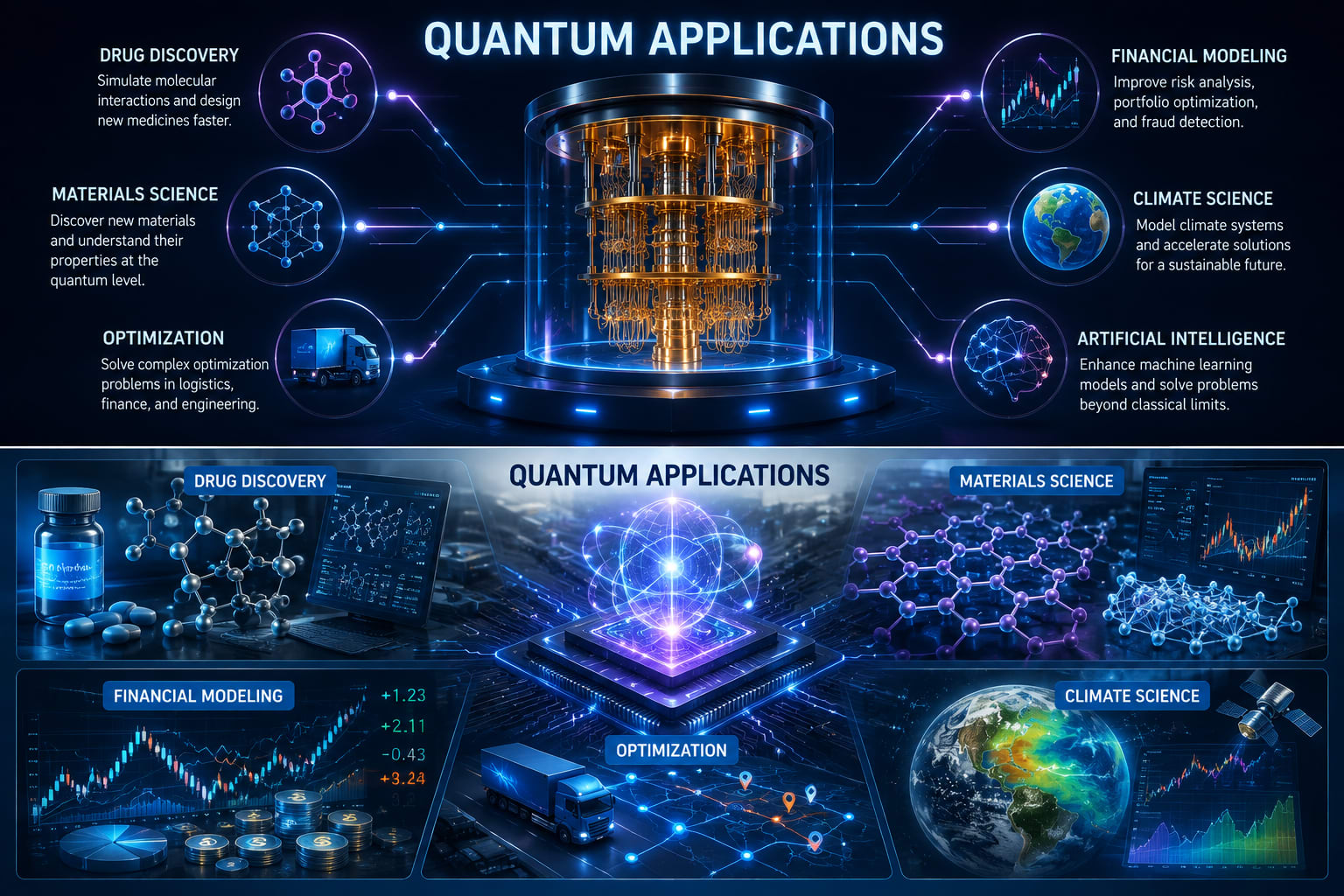
Real-World Solutions – Apply quantum computing to complex problems in science, healthcare, finance, and industry.
Advanced Research – Explore applications in drug discovery, materials science, optimization, and artificial intelligence.
Future Innovation – Discover how quantum technologies can improve efficiency, solve challenging problems, and create new opportunities.
The most consequential development in quantum applications over the past year is not a chip, a qubit count, or a speedup multiplier. It is a change in epistemics. Advantage claims are increasingly published with their circuits attached, invited into adversarial scrutiny, and sometimes withdrawn. The field is behaving more like a scientific discipline and less like a product category.
That is good news, and it should reorganise how professionals plan. If advantage is contested and revisable, then no single announcement justifies a strategic commitment, and no single refutation justifies dismissal. What justifies action is the shape of the evidence across classes: simulation ahead, chemistry promising but not yet superior, optimisation weak, machine learning speculative, and cryptographic migration urgent for reasons independent of all of the above.
The limitations of this assessment should be stated plainly. Several key 2026 results are preprints awaiting peer review. Vendor roadmaps are projections carrying disclosed risk. The classical baselines against which advantage is measured will improve in ways nobody can currently predict, and resource estimates have historically moved downward. Anyone offering a confident date for commercially decisive quantum computing is offering an opinion, not a finding.
What can be said with reasonable confidence is this: the organisations that will benefit first are not the ones that bought the most quantum compute. They are the ones that built enough internal understanding to recognise, when a genuinely relevant result arrives, that it is genuinely relevant — and to tell the difference between that and the version with a press release.
TOPIC
Quantum