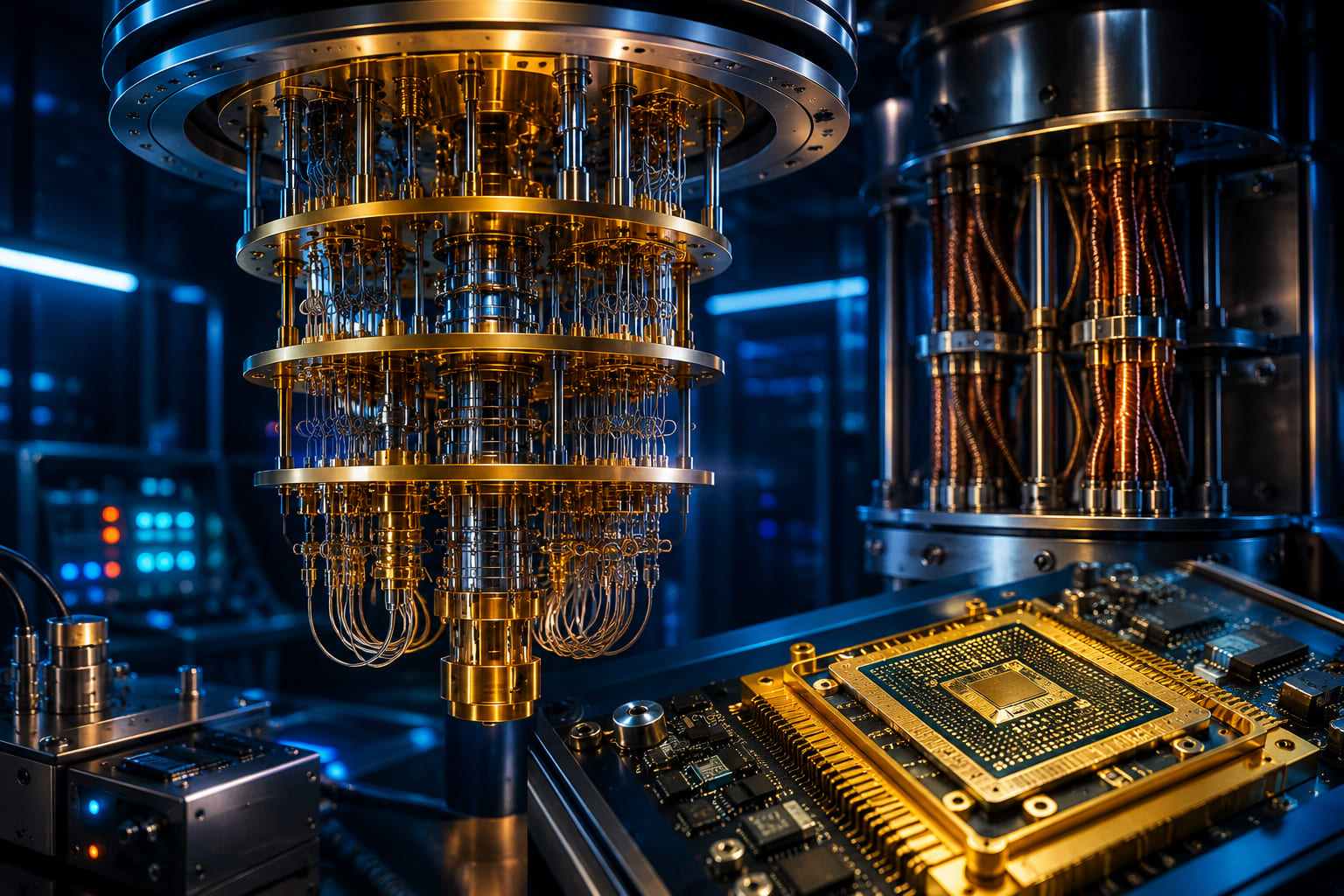
Quantum Hardware in 2026: Verification, Not Qubit Count, Is the Metric That Matters
For most of the past decade, quantum hardware was legible through a single number. Vendors announced qubit counts, the press reported them, and everyone understood roughly where things stood. That number was always a poor proxy for capability, but it was at least a common language.
That language has broken down — and the reason is progress, not stagnation. Between December 2024 and mid-2026, several groups crossed the threshold that quantum error correction theory had promised for thirty years: adding more physical qubits started making the encoded, or logical, qubit better rather than worse. Once that happens, the interesting quantity is no longer how many physical qubits a machine has, but how efficiently it converts them into reliable logical operations, how fast its decoder keeps up, and whether anyone outside the vendor has checked.
That last clause is where this article argues the field's real bottleneck now sits. Hardware capability is advancing faster than the collective ability to independently confirm what has been built. This is not a claim that vendors are dishonest. It is a claim about infrastructure: the machines are now complex enough, and the classical baselines they are measured against are moving fast enough, that a professional cannot evaluate a quantum hardware claim from a press release.
This piece is written for technology executives, CIOs and CISOs, R&D leads, procurement teams, investors, and researchers entering the field from adjacent disciplines. It sets out what changed in the hardware, why the standard metrics no longer work, which verification regimes are emerging, and how to read a hardware announcement without either dismissing it or over-trusting it.
Executive Summary
- Below-threshold quantum error correction has been demonstrated on multiple hardware platforms since December 2024. This is the single most consequential technical change in the field and it is peer-reviewed, not merely announced.
- Encoding efficiency — the ratio of physical to logical qubits — improved sharply during 2025 and 2026, with results reported in the low single digits rather than the tens or hundreds previously assumed.
- Physical qubit count has become close to meaningless as a comparison metric across platforms. Logical qubit count is on track to become similarly misleading unless code distance, gate set, and post-selection are disclosed alongside it.
- Verification infrastructure is now a distinct and strategically important layer of the ecosystem: DARPA's Quantum Benchmarking Initiative, community advantage trackers, and open-sourced classical baselines.
- The gap between a demonstrated logical qubit and a cryptographically relevant machine remains large — roughly one to two orders of magnitude in both logical qubit count and code distance.
- At least one prominent hardware programme — Microsoft's topological approach — remains genuinely disputed within the physics community, which is a useful reminder that "announced" and "established" are different categories.
- No single qubit modality has won. Superconducting, trapped-ion, neutral-atom, photonic, and spin-based approaches each have distinct and unresolved scaling risks.
- For most organisations, the correct 2026 posture is preparation and evaluation capability, not procurement — with the notable exception of post-quantum cryptography migration, which is time-sensitive for independent reasons.
What Actually Changed: The Evidence Base
Three results define the current moment, and it is worth separating them by evidentiary weight.
Below-threshold error correction (peer-reviewed). In December 2024, Google Quantum AI reported in Nature that its 105-qubit Willow processor produced a surface-code logical qubit whose error rate fell as the code distance increased. This is the qualitative transition the field had been working toward since Shor and Steane's mid-1990s codes: error correction that pays for itself. Comparable below-threshold behaviour has since been reported on neutral-atom hardware.
High-rate encoding (peer-reviewed). In January 2026, a QuEra–Harvard–MIT collaboration published in Nature a demonstration of 96 logical qubits encoded in 448 neutral atoms using high-rate [[16,6,4]] codes with below-threshold error suppression. The significance is the ratio, not the headline count: quantum low-density parity-check (qLDPC) and related high-rate codes break the assumption that fault tolerance requires a thousand physical qubits per logical one.
Efficient logical qubits on commercial hardware (company disclosure). Quantinuum's Helios system, launched in November 2025, reported 48 logical qubits from 98 physical trapped-ion qubits — roughly a 2:1 ratio — using concatenated colour codes on a charge-coupled-device ion trap architecture. This is a company disclosure supported by a preprint rather than a peer-reviewed result at the time of writing, and should be weighted accordingly.
The pattern across all three is the same. The scarce resource shifted from quantity of qubits to quality of encoding, and the engineering discipline shifted from physics demonstration to systems integration: decoders, control electronics, atom or ion transport, and fabrication yield.
Why the Old Metrics Stopped Working
Consider what a physical qubit count actually tells you across modalities. A superconducting qubit operates at roughly 10–20 millikelvin, gates in tens of nanoseconds, and has fixed lithographic connectivity. A neutral atom qubit is physically identical to every other atom of its species, can be moved mid-circuit by optical tweezers, and gates several orders of magnitude more slowly. A trapped-ion qubit has the best demonstrated gate fidelities and all-to-all connectivity but must be physically shuttled. These numbers are not commensurable. Comparing them is closer to comparing engine displacement across a motorcycle, a container ship, and a turbofan than to comparing transistor counts.
Logical qubit counts are better but degrade the same way once they become a marketing surface. A logical qubit at code distance 4 that only performs Clifford gates with post-selection is a fundamentally different object from a distance-25 logical qubit running a universal gate set with magic state distillation. Both can be reported as "one logical qubit."
The following framework is one way to structure evaluation. It is proposed here as an editorial tool, not a standard.
Table 1 — A Metric Hierarchy for Quantum Hardware Claims
| Tier | Metric | What it tells you | How easily it is gamed |
|---|---|---|---|
| 1 (weakest) | Physical qubit count | Manufacturing scale only | Trivially — count idle or low-quality qubits |
| 2 | Two-qubit gate fidelity | Component quality at best-case conditions | Easily — report best pair, not median or worst |
| 3 | Logical qubit count | That encoding works at some scale | Moderately — omit code distance or gate set |
| 4 | Encoding rate (logical ÷ physical) | Resource efficiency of the code | Moderately — depends on target error rate |
| 5 | Code distance and universal gate set | Whether deep circuits are possible | Harder — requires magic states or equivalent |
| 6 | Reliable logical operations per second | Actual computational throughput | Harder — end-to-end system property |
| 7 (strongest) | Independently verified end-to-end result | Whether the machine did something real | Hardest — requires an outside party |
A practical rule follows: if an announcement stops at tier 1 or 2, treat it as a manufacturing update. If it reaches tier 5 or above with disclosed conditions, treat it as a capability update.
The Modality Landscape Is Not Converging
A recurring error in enterprise planning is assuming a winning architecture will emerge shortly and that waiting is therefore cheap. The 2026 evidence does not support convergence. Each modality has a credible path and a distinct, unresolved risk.
Table 2 — Qubit Modalities: Strengths and Open Risks (as of August 2026)
| Modality | Representative programmes | Principal strength | Principal unresolved risk |
|---|---|---|---|
| Superconducting | IBM, Google, Rigetti, IQM | Fast gates; mature semiconductor fabrication | Cryogenic wiring and control I/O scaling; fixed connectivity |
| Trapped ion | Quantinuum, IonQ | Highest demonstrated fidelities; all-to-all connectivity | Slow clock speed; complexity of ion transport at scale |
| Neutral atom | QuEra, Pasqal, Atom Computing, Infleqtion | Identical qubits; software-defined connectivity; low per-qubit cost | Atom loss and reloading; optical control bandwidth above ~10,000 sites |
| Photonic | PsiQuantum, Xanadu | Leverages existing semiconductor fabs; room-temperature transport | Component loss budgets; enormous resource-state overhead |
| Silicon spin | Diraq, Quantum Motion, SQC, Intel-linked efforts | Potential CMOS manufacturability and density | Device-to-device variability; comparatively early fidelity results |
| Topological | Microsoft | Would need far fewer qubits if it works | Whether the underlying quasiparticles exist as claimed |
This diversity is itself a signal. Government evaluation programmes have deliberately funded across modalities rather than picking a winner, and the eleven companies advanced to Stage B of DARPA's Quantum Benchmarking Initiative in November 2025 span superconducting, trapped-ion, neutral-atom, photonic, and silicon-spin approaches.
The Argument: Verification Has Become the Scarce Resource
Here is the opinion this article defends. The most important quantum hardware developments of 2025–2026 are not chips. They are mechanisms for checking claims.
Three have emerged, and they operate at different levels.
Government-run technical audit. DARPA's Quantum Benchmarking Initiative asks a deliberately narrow question: can any approach reach utility-scale operation — computational value exceeding cost — by 2033? Its structure matters more than its funding. Stage A characterises a concept, Stage B subjects the R&D plan to a year of scrutiny, and Stage C grants government verification and validation teams direct access to designs, manufacturing lines, and performance data. PsiQuantum's expanded $125 million Stage C agreement, announced 22 July 2026, explicitly funds this access rather than the hardware itself. That is an unusual and healthy inversion of normal procurement.
Community-contested benchmarks. The open Quantum Advantage Tracker, launched by IBM with Algorithmiq, researchers at the Flatiron Institute, and BlueQubit, publishes advantage claims for classical researchers to attack. The IBM–Algorithmiq result announced on 30 July 2026 rests its case not on a speedup ratio but on survival: the problem had been open to classical challenge for eight months. Algorithmiq simultaneously open-sourced its own best classical method so that others can attack future claims, including its own. Whatever one thinks of the specific result, that structure is the right one, because the history of this field is a history of classical algorithms catching up after the fact.
Peer review as a filter. The clearest illustration is the contrast between what is settled and what is contested. Google's below-threshold result and QuEra's high-rate encoding went through Nature. Microsoft's topological programme has repeatedly presented major claims at conferences and in preprints; in June 2026 the company reported parity lifetimes exceeding 20 seconds in an indium-arsenide–lead tetron device, framed as a thousand-fold improvement and accompanied by an accelerated 2029 timeline. Physicists including Henry Legg of the University of St Andrews responded that the new data does not address their fundamental objections, and the reported measurements do not include the joint-parity measurement that would demonstrate qubit behaviour. Notably, when Microsoft published in Nature in early 2025, the journal's editors appended a note stating that the results did not constitute evidence for Majorana zero modes.
The point is not that Microsoft is wrong. Topological qubits may yet work, and the materials engineering is genuinely difficult and genuinely improving. The point is that a professional reader can only distinguish these cases by attending to the verification path, and that this distinction is now the most informative thing about any given announcement.
What Is Still Unsolved
Balance requires stating plainly how far this is from finished.
Scale. Resource estimates for factoring RSA-2048 have fallen substantially — from roughly twenty million noisy qubits in the 2019 Gidney–Ekerå estimate to under one million in Gidney's 2025 revision — but that improvement came largely from better algorithms and codes, not from hardware. Current demonstrations sit at code distances of roughly 4 to 7; fault-tolerant cryptanalysis needs distances several times larger, and logical qubit counts one to two orders of magnitude higher.
Decoder latency. Error syndromes must be decoded faster than they accumulate. IBM reported real-time decoding under 480 nanoseconds using qLDPC codes in November 2025, described as a year ahead of its own schedule. This is a classical computing problem embedded in a quantum machine, and it scales unfavourably.
Non-Clifford operations. Most demonstrations remain Clifford-dominated or rely on small magic state factories. Universal computation at scale requires magic state distillation with overheads that current systems have only begun to demonstrate.
Manufacturing and supply chain. IBM's shift to 300mm wafer fabrication at the Albany NanoTech Complex, and the clustering of cryogenic and laser suppliers around facilities such as the Illinois Quantum and Microelectronics Park, indicate that the field has entered its industrialisation phase — with the concentration risk that implies. Dilution refrigerators, high-power stabilised lasers, superconducting nanowire detectors, and specialised RF electronics all have thin supplier bases.
Energy and environment. Quantum processors are frequently described as energy-efficient relative to the classical computation they would replace. That claim is plausible for specific workloads but is not well substantiated at system level once cryogenics, laser systems, and classical co-processing are included. It should be treated as an open question rather than an established benefit.
Callout — A useful heuristic Ask of any hardware claim: Who could have proven this wrong, and did they try? If the answer is "the vendor's own team," the claim is a hypothesis. If it is "a journal referee, a competing classical algorithms group, or a government audit team," it is evidence.
Latest Developments
Dated and distinguished by evidentiary status.
- 22 October 2025 (peer-reviewed, contested interpretation). Google Quantum AI published in Nature a "Quantum Echoes" out-of-time-order correlator experiment on Willow, reporting a result roughly 13,000 times faster than the best classical algorithm tested on a leading supercomputer. Speedup ratios of this kind depend on the classical baseline chosen and should be regarded as provisional.
- 5 November 2025 (company disclosure). Quantinuum launched Helios: 98 physical qubits, 48 reported logical qubits, junction-based ion routing, with follow-on systems Sol (2027) and Apollo (2029–2030) on its published roadmap.
- 6 November 2025 (government programme). DARPA advanced eleven companies to QBI Stage B: Atom Computing, Diraq, IBM, IonQ, Nord Quantique, Photonic Inc., Quantinuum, Quantum Motion, QuEra, Silicon Quantum Computing, and Xanadu. Several Stage A participants did not advance, which is informative in itself.
- 12 November 2025 (company disclosure). IBM introduced Nighthawk (120 qubits, square lattice, circuits up to 5,000 two-qubit gates) and the experimental Loon processor, alongside sub-480-nanosecond real-time qLDPC decoding and a move to 300mm wafer fabrication.
- January 2026 (peer-reviewed). QuEra, Harvard, and MIT reported 96 logical qubits from 448 atoms with below-threshold error suppression in Nature.
- June 2026 (preprint, disputed). Microsoft reported >20-second parity lifetimes in an InAs–Pb tetron and accelerated its scalable-machine timeline to 2029. Independent physicists publicly disputed the interpretation.
- 22 July 2026 (government contract). PsiQuantum signed an expanded $125 million DARPA agreement under QBI Stage C, following a $31.8 million award in September 2025; its CEO indicated a first commercial-scale machine around 2030.
- 30 July 2026 (company disclosure with open challenge). IBM announced quantum advantage demonstrations with Algorithmiq, Qedma, and the University of Chicago, framed around trusted computation where classical verification is unavailable, with the underlying problem having been open to classical challenge for eight months.
Practical Takeaways
For CIOs and technology executives. Do not buy hardware. Do build an internal capability to evaluate claims — one or two people who can read a preprint and ask about code distance and post-selection is a better investment in 2026 than any quantum compute contract. Treat vendor roadmaps as directional statements of intent, and track whether each vendor has historically hit its own published dates.
For CISOs and risk owners. Post-quantum cryptography migration is decoupled from hardware timelines. Harvest-now-decrypt-later exposure is determined by how long your data must remain confidential, not by when a cryptographically relevant machine arrives. The NIST standards FIPS 203, 204, and 205 have been final since August 2024; inventory and migration planning should already be underway regardless of your view on quantum timelines.
For R&D and innovation leads. Focus on problem framing rather than platform selection. The workloads with credible near-term relevance are quantum simulation of quantum systems — materials, catalysis, and molecular dynamics. Optimisation and machine learning claims deserve more scepticism, because strong classical baselines exist and frequently win.
For investors and analysts. Weight independent verification signals over qubit counts and funding rounds. DARPA Stage advancement, peer-reviewed publication, and survival on open benchmark trackers are the closest available proxies for technical due diligence.
For researchers and engineers entering the field. The demand curve has shifted toward classical systems skills applied to quantum machines: real-time decoding, control electronics, compilation, and calibration automation. Stabiliser formalism and error-correction literacy are now baseline requirements rather than specialisations.
Key Insights
- Below-threshold error correction is established across more than one hardware platform and is peer-reviewed.
- Encoding efficiency improved by roughly an order of magnitude between 2024 and 2026, driven by high-rate qLDPC and concatenated codes.
- Physical qubit count is no longer a meaningful cross-platform comparison metric.
- Logical qubit count is meaningful only when reported with code distance, gate set, and post-selection conditions.
- Decoder latency is a classical computing bottleneck now sitting on the critical path of quantum scaling.
- No modality has won; government programmes are deliberately funding across all of them.
- Verification infrastructure — audits, trackers, open baselines — is the field's most important recent institutional development.
- At least one major hardware claim remains scientifically disputed, which should calibrate expectations for all announcements.
- Resource estimates for cryptanalysis fell mainly through algorithmic improvement, not hardware progress.
- Post-quantum cryptography migration should proceed independently of any view on quantum hardware timelines.
Figure Briefs for the OneWise Design Team
Figure 1 — "The Metric Hierarchy: How to Read a Quantum Hardware Claim" Purpose: give readers a visual triage tool. Form: vertical seven-step pyramid or staircase, narrowest at top. Components, bottom to top: Physical qubit count → Gate fidelity → Logical qubit count → Encoding rate → Code distance and gate set → Reliable logical operations per second → Independently verified result. Labels: left-hand axis labelled "Marketing surface" at the bottom, "Capability evidence" at the top. A right-hand column shows "How easily gamed", shaded from red at the base to green at the apex. Caption suggestion: "Higher tiers require disclosure that is harder to omit — and harder to overstate."
Figure 2 — "From Physical Qubits to a Verified Result: The Modern Hardware Stack" Purpose: show that hardware is now a system, not a chip. Form: horizontal left-to-right flow with a feedback loop. Sequence: Physical qubit layer (labelled with modality icons) → Control and readout electronics → Syndrome extraction → Real-time decoder (annotate: "must run faster than errors accumulate") → Logical qubit layer → Magic state factory (annotate: "enables non-Clifford gates") → Logical circuit execution → Classical post-processing → Independent verification (annotate: "peer review · audit · open benchmark"). Feedback arrow: from the decoder back to control and readout, labelled "correction feedback." Visual hierarchy: physical layers in cool tones, logical layers in warm tones, verification stage outlined and visually separated to emphasise that it sits outside the vendor's control. Caption suggestion: "Most of the difficulty in 2026 lies between the qubits and the answer."
Frequently Asked Questions
What is a logical qubit? A logical qubit is a single unit of quantum information encoded redundantly across many physical qubits so that errors can be detected and corrected. It is the unit that matters for running real algorithms.
How many physical qubits does one logical qubit require? It depends entirely on the code and target error rate. Surface codes were long assumed to need hundreds to thousands per logical qubit. High-rate qLDPC and concatenated codes reported in 2025–2026 have brought demonstrated ratios into the low single digits — but at modest code distances, which is not the same regime as deep fault-tolerant computation.
What does "below threshold" mean? It means adding more physical qubits to a code makes the encoded logical qubit better rather than worse. Below threshold, error correction is a net gain; above it, redundancy adds more noise than it removes.
Has quantum advantage been achieved? Several demonstrations have been announced, most recently in July 2026, and some have withstood classical challenge for months. "Advantage" here means outperforming known classical methods on a specific scientific task — not general commercial usefulness. Classical algorithms have historically caught up with earlier claims, so treat all such results as provisional.
Which qubit technology will win? No credible evidence currently supports a single winner. Government evaluation programmes are funding across superconducting, trapped-ion, neutral-atom, photonic, and silicon-spin approaches simultaneously.
When will quantum computers break encryption? Nobody knows. Published resource estimates have fallen substantially, but current hardware remains roughly one to two orders of magnitude short in both logical qubit count and code distance. Risk assessments should be driven by data confidentiality lifetimes rather than by timeline forecasts.
Should my organisation buy quantum hardware in 2026? For the overwhelming majority of organisations, no. Cloud access for experimentation and internal capability-building offer better returns than capital purchases.
What is DARPA's Quantum Benchmarking Initiative? A U.S. government programme evaluating whether any quantum computing approach can achieve utility-scale operation — value exceeding cost — by 2033, through staged technical audits culminating in direct government verification and validation.
What is a qLDPC code? Quantum low-density parity-check codes are error-correcting codes that encode more logical qubits per physical qubit than the surface code, at the cost of requiring longer-range connectivity between qubits.
Why does decoder speed matter? Errors accumulate continuously. If the classical decoder that identifies them cannot keep pace, the correction arrives too late and the computation fails regardless of qubit quality.
What is magic state distillation? A procedure for producing the special quantum states needed to perform non-Clifford gates fault-tolerantly. Without it, error-corrected machines cannot run universal quantum algorithms.
Are quantum computers more energy-efficient than classical ones? For specific workloads the comparison may favour quantum machines, but system-level accounting including cryogenics, lasers, and classical co-processing is not well established. This should be treated as an open question.
What should a non-specialist look for in a hardware announcement? Code distance, gate set, whether results are post-selected, whether the work is peer-reviewed or a preprint, and whether any independent party could have falsified the claim.
Is post-quantum cryptography a substitute for quantum computing readiness? They are separate programmes. PQC migration addresses a defensive risk with a known solution and existing standards. Quantum computing readiness addresses a potential capability with uncertain timelines.
Glossary
- Code distance — a measure of how many simultaneous physical errors a quantum error-correcting code can tolerate; roughly, its robustness.
- Clifford gates — a set of quantum gates that is efficiently simulable classically and therefore insufficient on its own for quantum advantage.
- Cryogenics — the refrigeration systems, typically dilution refrigerators, required to cool superconducting and some other qubit types near absolute zero.
- Decoder — classical software or hardware that interprets error syndromes and determines what correction to apply.
- Encoding rate — the ratio of logical qubits to physical qubits in a given code.
- Fault tolerance — the property of a system that can compute reliably for arbitrarily long despite component errors.
- FIPS 203/204/205 — the U.S. federal post-quantum cryptography standards finalised by NIST in August 2024.
- Logical qubit — an error-corrected qubit encoded across multiple physical qubits.
- Magic state distillation — a resource-intensive procedure enabling fault-tolerant non-Clifford gates.
- Majorana zero mode — a hypothesised quasiparticle state that would enable topologically protected qubits; its experimental realisation remains disputed.
- NISQ — Noisy Intermediate-Scale Quantum; the era of uncorrected devices the field is now leaving.
- Post-selection — discarding runs in which errors were detected, which improves reported results but does not by itself constitute error correction.
- QCCD — quantum charge-coupled device; a trapped-ion architecture in which ions are physically transported between operation zones.
- qLDPC — quantum low-density parity-check codes; high-rate codes requiring longer-range qubit connectivity.
- Surface code — a widely studied error-correcting code requiring only nearest-neighbour connectivity, at the cost of a low encoding rate.
- Threshold — the physical error rate below which error correction improves as more qubits are added.
References
All sources listed were consulted in preparing this article. Where a claim rests on a company disclosure rather than peer-reviewed work, this is stated in the text.
Academic Papers and Preprints
Bluvstein, D., et al. (2026). Architectural mechanisms of a universal fault-tolerant quantum computer. Nature. https://doi.org/10.1038/s41586-025-09848-5
Gidney, C. (2025). How to factor 2048 bit RSA integers with less than a million noisy qubits (arXiv:2505.15917) [Preprint]. arXiv. https://arxiv.org/abs/2505.15917
Gidney, C., & Ekerå, M. (2021). How to factor 2048 bit RSA integers in 8 hours using 20 million noisy qubits. Quantum, 5, 433. https://doi.org/10.22331/q-2021-04-15-433
Google Quantum AI and Collaborators. (2025). Observation of constructive interference at the edge of quantum ergodicity. Nature. https://www.nature.com/nature
Google Quantum AI. (2024). Quantum error correction below the surface code threshold. Nature, 638, 920–926. https://doi.org/10.1038/s41586-024-08449-y
Algorithmiq & IBM Quantum. (2026). Trusted quantum simulation of heterogeneous quantum matter (arXiv:2607.25998) [Preprint]. arXiv. https://arxiv.org/abs/2607.25998
Wang, et al. (2026). Neutral atom quantum computing: Principles, routes, progress, and challenges (arXiv:2608.05010) [Preprint]. arXiv. https://arxiv.org/abs/2608.05010
Official Documentation and Company Disclosures
IBM. (2026). IBM Quantum roadmap. https://www.ibm.com/roadmaps/quantum/
IBM Quantum. (2025). IBM lays out clear path to fault-tolerant quantum computing. https://www.ibm.com/quantum/blog/large-scale-ftqc
IBM. (2026, July 30). IBM and Algorithmiq demonstrate quantum advantage, establishing a framework for trusted quantum computation beyond classical verification [Press release]. https://newsroom.ibm.com/
Google Research. (2025). A verifiable quantum advantage. https://research.google/blog/a-verifiable-quantum-advantage/
Quantinuum. (2024). Technical perspective: By the end of the decade, we will deliver universal, fully fault-tolerant quantum computing. https://www.quantinuum.com/blog
Quantinuum. (2025). Quantinuum selected by DARPA to advance to Stage B of the Quantum Benchmarking Initiative [Press release]. https://www.quantinuum.com/press-releases
PsiQuantum. (2026, July 22). PsiQuantum signs $125 million agreement with DARPA [Press release]. https://www.psiquantum.com/
QuEra Computing. (2026). Neutral atoms and the path to fault-tolerant quantum computing. https://www.quera.com/
Government Sources and Standards
Defense Advanced Research Projects Agency. (2025). Quantum Benchmarking Initiative: Stage B selection. U.S. Department of Defense. https://www.darpa.mil/research/programs/quantum-benchmarking-initiative
National Institute of Standards and Technology. (2024). FIPS 203: Module-lattice-based key-encapsulation mechanism standard. U.S. Department of Commerce. https://doi.org/10.6028/NIST.FIPS.203
National Institute of Standards and Technology. (2024). FIPS 204: Module-lattice-based digital signature standard. U.S. Department of Commerce. https://doi.org/10.6028/NIST.FIPS.204
National Institute of Standards and Technology. (2024). FIPS 205: Stateless hash-based digital signature standard. U.S. Department of Commerce. https://doi.org/10.6028/NIST.FIPS.205
Journalism and Industry Analysis
American Physical Society. (2025). Microsoft's claim of a topological qubit faces tough questions. Physics, 18, 68. https://doi.org/10.1103/Physics.18.68
Conover, E. (2026, June 2). Microsoft's quantum chip got an upgrade. Critics are still skeptical. Science News. https://www.sciencenews.org/
Conover, E. (2025, October 22). Quantum "echoes" reveal the potential of Google's quantum computer. Science News. https://www.sciencenews.org/
HPCwire. (2025, November 5). Quantinuum introduces Helios quantum system as roadmap advances toward Apollo. https://www.hpcwire.com/
Reuters. (2026, July 22). Quantum computing startup PsiQuantum signs $125 million DARPA deal.
Quantum Computing Report. (2026). News archive. https://quantumcomputingreport.com/news/
This article was researched and written by the OneWise editorial team using publicly available primary sources, peer-reviewed literature, official technical documentation, and government publications. It does not represent first-hand laboratory experience with the systems described, and it distinguishes throughout between peer-reviewed results, preprints, and company disclosures. Where evidence is disputed, competing positions are presented.
One Tech & AI · Tuesday, August 11, 2026 · 23 min read
Quantum Processors – Explore the physical systems and qubits used to build powerful quantum computers.
Hardware Innovation – Learn about advances in quantum chips, cooling systems, control technologies, and error correction.
Future Computing – Discover how improved quantum hardware can enable faster solutions for complex scientific and industrial problems.
The quantum hardware field spent thirty years trying to prove that error correction could work in practice. That question is now substantially answered, on more than one platform, in peer-reviewed literature. It is a real achievement and it deserves to be recognised as such without inflation.
What follows is harder to narrate and harder to sell. The remaining problems are engineering problems at system scale: decoders that must outrun physics, magic state factories with punishing overheads, cryogenic and optical infrastructure with thin supply chains, and manufacturing yields that have to improve by orders of magnitude. These are the kinds of problems that take longer than roadmaps assume and are resolved by unglamorous incremental work.
In the meantime, the most useful skill a professional can develop is not technical fluency in quantum mechanics but epistemic discipline about claims. The field's own institutions have grasped this: government auditors with access to manufacturing lines, open benchmark trackers that invite classical refutation, and companies releasing the classical methods that could defeat their own results. That is what a maturing technology looks like from the inside.
The honest summary is that quantum hardware in 2026 is genuinely further along than most sceptics expected and genuinely further from commercial utility than most enthusiasts imply. Both statements are supported by the same evidence. The organisations that navigate the next five years well will be the ones that can hold both at once — and that judge each new announcement by who had the opportunity to prove it wrong.
TOPIC
Quantum